
What is a Basal Cell Carcinoma?
- Dr Duncan Lowe
- Jun 19
- 4 min read
A basal cell carcinoma (BCC) is the most common type of skin cancer.
The good news is that BCCs grow very slowly, are highly treatable, and almost never spread to other parts of the body. However, if left untreated, they can continue to grow and cause damage to the surrounding skin and tissue. Early assessment and treatment can usually prevent this and often result in a straightforward cure.
What Does a BCC Look Like?
Basal cell carcinomas can appear in several different ways, which is why they are sometimes mistaken for harmless skin lesions.
Common signs of a BCC include:
A slowly growing lump or patch on the skin
A pearly or shiny appearance
Small visible blood vessels on the surface
A pink, red, or skin-coloured lesion
A sore that repeatedly scabs but does not heal
Bleeding after minor trauma or washing
Persistent itching
Ulceration or crusting
BCCs most commonly develop on areas that receive significant sun exposure, particularly the:
Face
Nose
Ears
Eyelids
Scalp
Neck
If you have a lesion that has been present for several months and continues to change or fail to heal, it is worth having it assessed by a skin specialist.
What Causes Basal Cell Carcinoma?
Basal cell carcinomas develop when damage accumulates within the skin cells over time.
The biggest risk factor is exposure to ultraviolet (UV) light from the sun. Factors that increase your risk include:
Sun Exposure
The risk is higher in:
Fair-skinned individuals
People who burn easily
Those with a history of repeated sunburn
Sunbed users
Older adults with greater lifetime sun exposure
Reduced Immune Function
The immune system plays an important role in identifying and removing abnormal cells.
Risk can be increased in:
Organ transplant recipients
People with blood cancers such as leukaemia
Patients taking certain immune-suppressing medications
Older adults
Chronic Wounds
Long-standing wounds or ulcers can occasionally become cancerous because the skin is constantly attempting to repair itself.
Genetic Conditions
Some rare inherited conditions, such as Gorlin syndrome, can increase the likelihood of developing multiple BCCs.
Different Types of BCC
Not all basal cell carcinomas behave in exactly the same way.
Superficial BCC
Superficial BCCs are usually flat, red or pink patches on the skin. They often resemble eczema or a persistent rash and may be itchy or occasionally bleed.
Nodular BCC
This is the most common type. It usually appears as a shiny, pearly lump with visible blood vessels and may gradually enlarge over time.
Higher-Risk BCCs
Some subtypes, including morphoeic, infiltrative and micronodular BCCs, can spread more extensively beneath the skin than is visible on the surface. Although these still rarely spread elsewhere in the body, they can be more challenging to treat and may require larger surgery to achieve complete removal.
How Is BCC Diagnosed?
Most basal cell carcinomas can be diagnosed during a consultation with an experienced skin specialist. A dermatoscope - a handheld magnifying device used to examine the skin in detail - is often used to help confirm the diagnosis. Occasionally, if the diagnosis is uncertain, a small biopsy may be recommended. This involves taking a sample of tissue for laboratory analysis.
Some harmless skin lesions can closely resemble BCCs, including:
Intradermal moles
Sebaceous hyperplasia (enlarged oil glands)
Certain benign skin growths
This is why professional assessment is important.
How Is BCC Treated?
Treatment depends on:
The size of the lesion
Its location
The subtype of BCC
Whether it has been treated previously
Surgical Removal
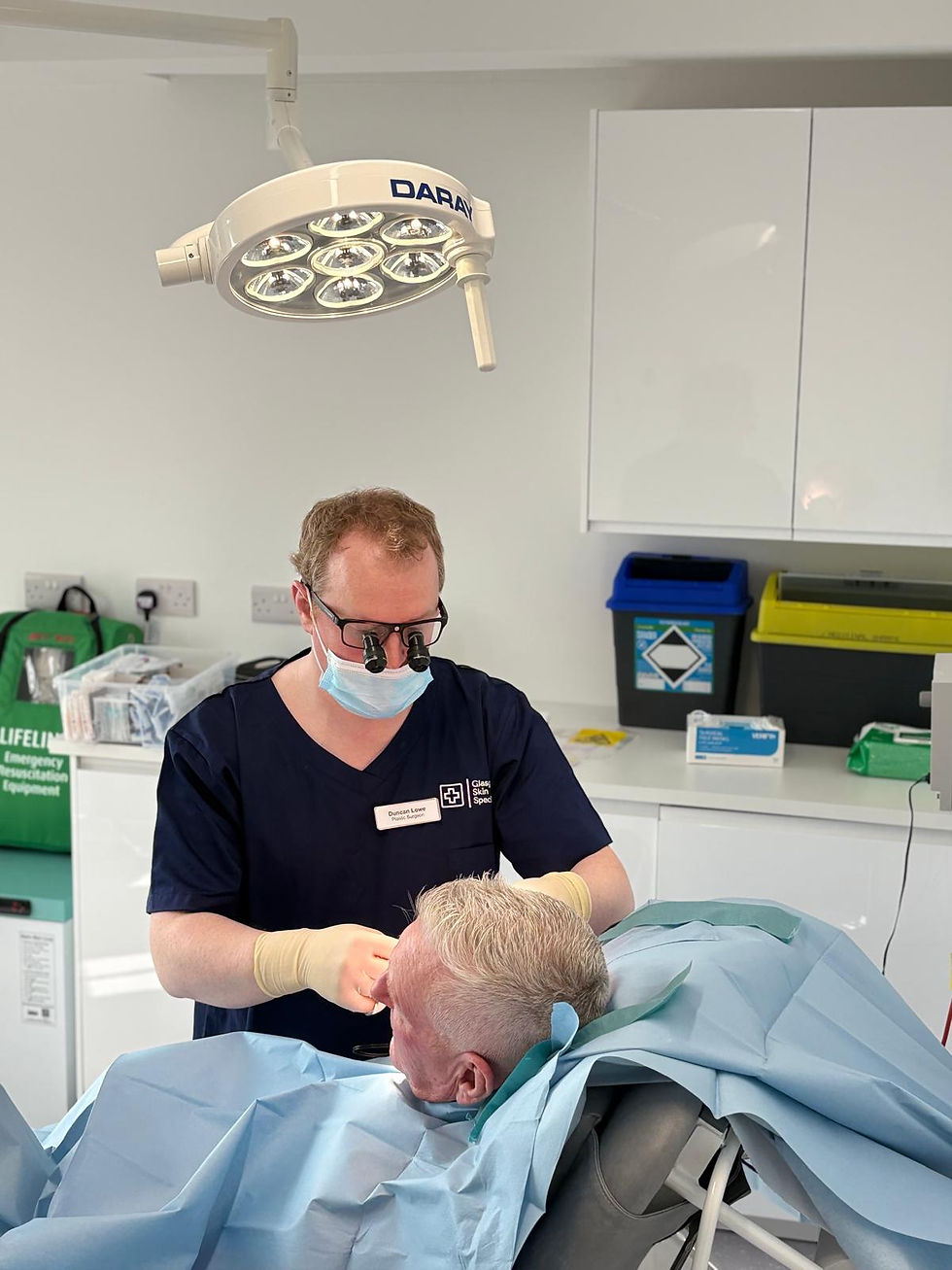
Most BCCs are treated with a simple surgical procedure under local anaesthetic.
The cancer is removed together with a small margin of normal-looking skin to maximise the chance of complete removal. For most patients this is a straightforward day-case procedure. The success rate for complete removal with a single operation is approximately 95%.
Cream Treatments
Some superficial BCCs can be treated without surgery using prescription creams such as:
Imiquimod
Fluorouracil
These treatments are not suitable for all BCCs and require careful assessment beforehand.
Reconstruction
After removal, the wound can often be closed with stitches. For larger lesions or those in more complex areas such as the nose, ear or scalp, reconstruction using local skin flaps or skin grafts may occasionally be required.
What Happens If a BCC Is Left Untreated?
Although BCCs rarely spread elsewhere in the body, they do not usually disappear on their own. Over time they can:
Continue to enlarge
Ulcerate
Bleed
Damage surrounding skin and tissue
Become more difficult to remove surgically
Early treatment is generally simpler and often results in a better cosmetic outcome.
What Is the Long-Term Outlook?
The outlook following treatment for a basal cell carcinoma is excellent. Once a BCC has been completely removed, the chance of it returning is very low. However, people who have had one BCC are more likely to develop another skin cancer in the future. For this reason, it is important to:
Check your skin regularly
Protect yourself from excessive sun exposure
Seek advice if you notice any new or changing lesions
Assessment at Glasgow Skin Specialists
At Glasgow Skin Specialists, suspected basal cell carcinomas are assessed by experienced skin surgery specialists.
In many cases, a diagnosis can be made during your consultation, allowing us to discuss treatment options and arrange prompt management where appropriate.
If you are concerned about a skin lesion, we would be happy to assess it and advise on the most appropriate next steps.
Concerned about a possible skin cancer? Contact Glasgow Skin Specialists to arrange an assessment with our experienced skin surgery team.



Comments